
数据操作
概念
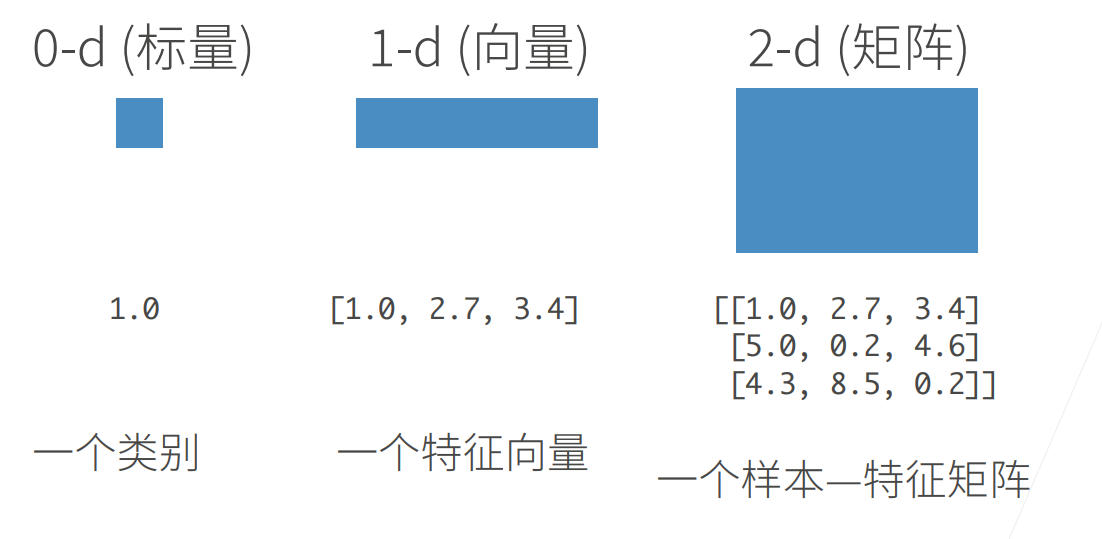
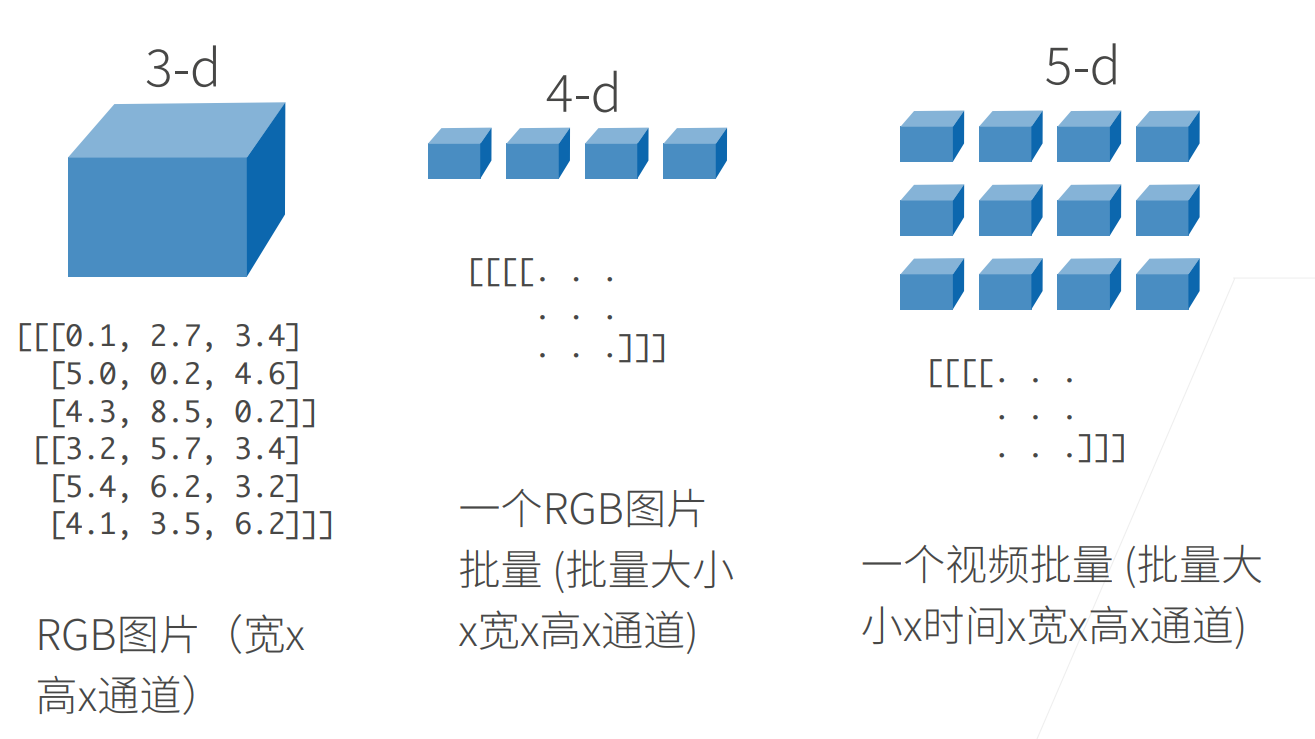
N维数组是机器学习和神经网络的主要数据结构,如下图所示:
常见操作
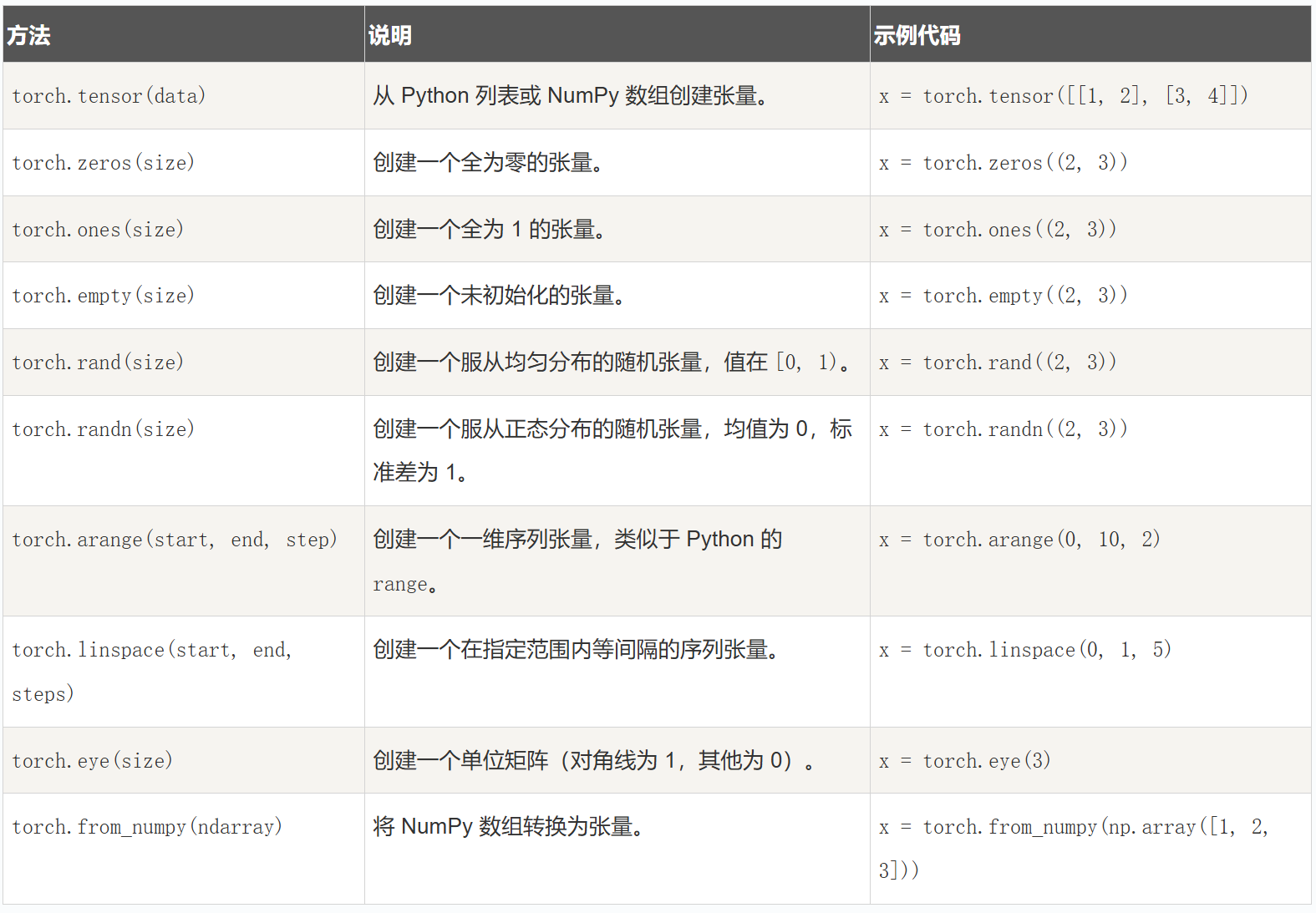
创建张量
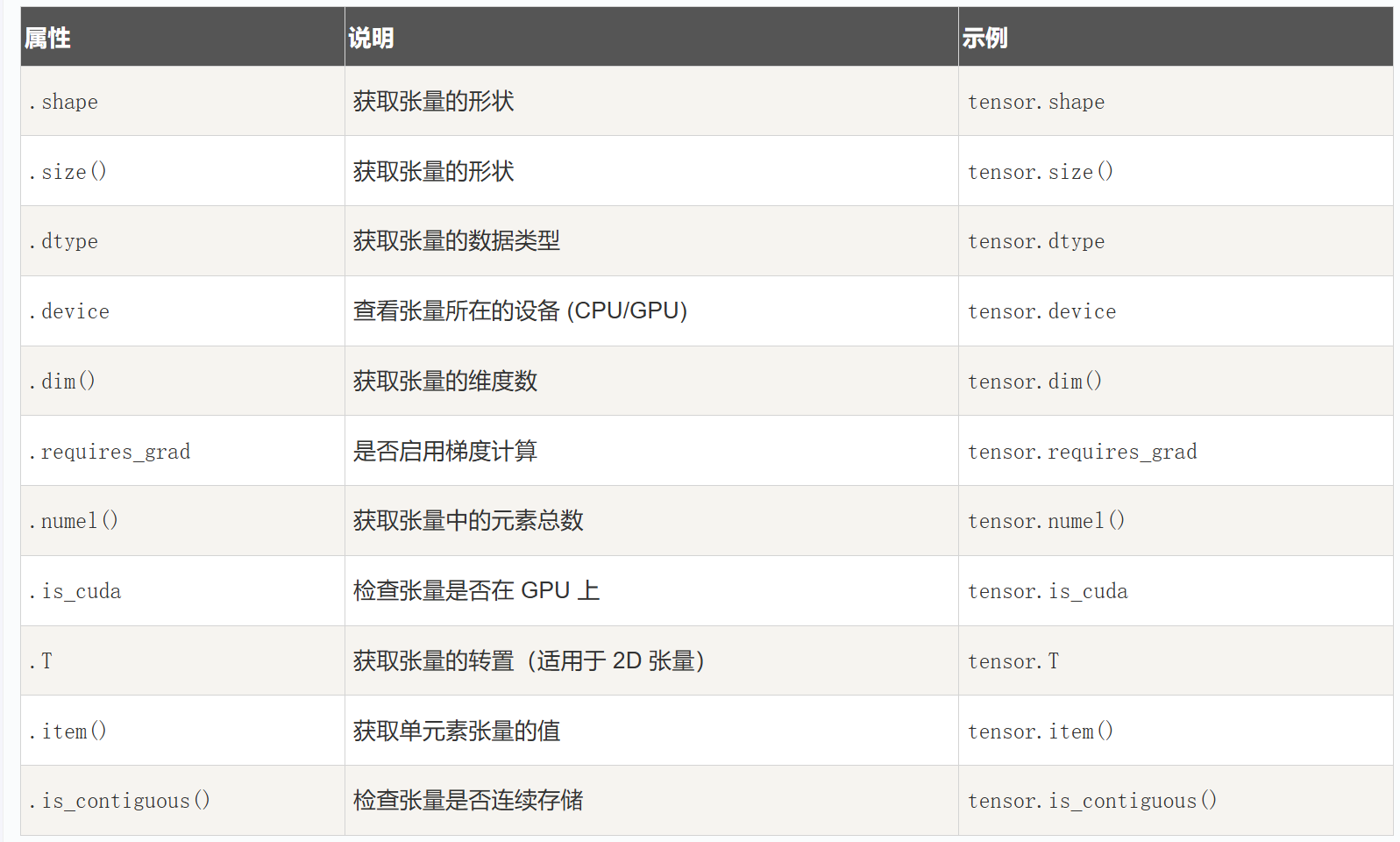
张量的属性
实践
具体运行内容可见:
详情
<!-- #include-env-start: D:/code/klc/test/share4ai/docs/book/dive_into_on_dl/dl_basic -->
```python
import torch
scalar=torch.tensor(7)
scalar.ndim
0
scalar.item()
7
vector = torch.tensor([7, 7])
vector
tensor([7, 7])
# 维度 dimension
print(vector.ndim)
print(vector.dim())
1
1
vector.shape
torch.Size([2])
# Matrix
MATRIX = torch.tensor([[7, 8],
                       [9, 10]])
MATRIX.ndim,MATRIX.shape
(2, torch.Size([2, 2]))
# Tensor
TENSOR = torch.tensor([[[1, 2, 3],
                        [3, 6, 9],
                        [2, 4, 5]]])
TENSOR
tensor([[[1, 2, 3],
         [3, 6, 9],
         [2, 4, 5]]])
TENSOR.ndim
TENSOR.shape
torch.Size([1, 3, 3])
random_tensor = torch.rand(size=(3, 4))
random_tensor, random_tensor.dtype
(tensor([[0.9263, 0.1787, 0.2141, 0.0935],
         [0.0975, 0.8770, 0.2748, 0.6494],
         [0.9494, 0.6937, 0.3800, 0.3545]]),
 torch.float32)
# Create a tensor of all zeros
zeros = torch.zeros(size=(3, 4))
zeros, zeros.dtype
(tensor([[0., 0., 0., 0.],
         [0., 0., 0., 0.],
         [0., 0., 0., 0.]]),
 torch.float32)
# Create a tensor of all ones
ones = torch.ones(size=(3, 4))
ones, ones.dtype
(tensor([[1., 1., 1., 1.],
         [1., 1., 1., 1.],
         [1., 1., 1., 1.]]),
 torch.float32)
# Create a range of values 0 to 10
zero_to_ten = torch.arange(start=0, end=10, step=1)
zero_to_ten
tensor([0, 1, 2, 3, 4, 5, 6, 7, 8, 9])
# Can also create a tensor of zeros similar to another tensor
ten_zeros = torch.zeros_like(input=zero_to_ten) # will have same shape
print(ten_zeros)
ten_ones = torch.ones_like(input=zero_to_ten) # will have same shape
print(ten_ones)
tensor([0, 0, 0, 0, 0, 0, 0, 0, 0, 0])
tensor([1, 1, 1, 1, 1, 1, 1, 1, 1, 1])
float_32_tensor = torch.tensor(data=[5,6,7],dtype=torch.float32)
float_32_tensor,float_32_tensor.dtype
(tensor([5., 6., 7.]), torch.float32)
# Create a tensor
some_tensor = torch.rand(3, 4)

# Find out details about it
print(some_tensor)
print(f"Shape of tensor: {some_tensor.shape}")
print(f"Datatype of tensor: {some_tensor.dtype}")
print(f"Device tensor is stored on: {some_tensor.device}") # will default to CPU
tensor([[0.1438, 0.8729, 0.1077, 0.5648],
        [0.7661, 0.2413, 0.0707, 0.3947],
        [0.8517, 0.7686, 0.3598, 0.2205]])
Shape of tensor: torch.Size([3, 4])
Datatype of tensor: torch.float32
Device tensor is stored on: cpu
# Manipulating tensors
# Create a tensor of values and add a number to it
tensor = torch.tensor([1, 2, 3])
print(tensor + 10)

# Subtract and reassign
print(tensor-10)

# Multiply it by 10
print(tensor * 10)
print(torch.multiply(tensor, 10))

# Division it by 10
print(tensor / 10)
tensor([11, 12, 13])
tensor([-9, -8, -7])
tensor([10, 20, 30])
tensor([10, 20, 30])
tensor([0.1000, 0.2000, 0.3000])
# Element-wise multiplication (each element multiplies its equivalent, index 0->0, 1->1, 2->2)
print(tensor, "*", tensor)
print("Equals:", tensor * tensor)
tensor([1, 2, 3]) * tensor([1, 2, 3])
Equals: tensor([1, 4, 9])
# Matrix multiplication
torch.matmul(tensor, tensor)
tensor(14)
# Shapes need to be in the right way
tensor_A = torch.tensor([[1, 2],
                         [3, 4],
                         [5, 6]], dtype=torch.float32)

tensor_B = torch.tensor([[7, 10],
                         [8, 11],
                         [9, 12]], dtype=torch.float32)

torch.matmul(tensor_A, tensor_B)
---------------------------------------------------------------------------

RuntimeError                              Traceback (most recent call last)

Cell In[49], line 10
      2 tensor_A = torch.tensor([[1, 2],
      3                          [3, 4],
      4                          [5, 6]], dtype=torch.float32)
      6 tensor_B = torch.tensor([[7, 10],
      7                          [8, 11],
      8                          [9, 12]], dtype=torch.float32)
---> 10 torch.matmul(tensor_A, tensor_B)


RuntimeError: mat1 and mat2 shapes cannot be multiplied (3x2 and 3x2)
# The operation works when tensor_B is transposed
print(f"Original shapes: tensor_A = {tensor_A.shape}, tensor_B = {tensor_B.shape}\n")
print(f"New shapes: tensor_A = {tensor_A.shape} (same as above), tensor_B.T = {tensor_B.T.shape}\n")
print(f"Multiplying: {tensor_A.shape} * {tensor_B.T.shape} <- inner dimensions match\n")
print("Output:\n")
output = torch.matmul(tensor_A, tensor_B.T)
print(output)
print(f"\nOutput shape: {output.shape}")
Original shapes: tensor_A = torch.Size([3, 2]), tensor_B = torch.Size([3, 2])

New shapes: tensor_A = torch.Size([3, 2]) (same as above), tensor_B.T = torch.Size([2, 3])

Multiplying: torch.Size([3, 2]) * torch.Size([2, 3]) <- inner dimensions match

Output:

tensor([[ 27.,  30.,  33.],
        [ 61.,  68.,  75.],
        [ 95., 106., 117.]])

Output shape: torch.Size([3, 3])
# Since the linear layer starts with a random weights matrix, let's make it reproducible (more on this later)
torch.manual_seed(42)
<torch._C.Generator at 0x1ddede26810>
# Since the linear layer starts with a random weights matrix, let's make it reproducible (more on this later)
torch.manual_seed(42)
# This uses matrix mutliplcation
# 输入样本的维度2,输出样本维度6
linear = torch.nn.Linear(in_features=2, # in_features = matches inner dimension of input
                         out_features=6) # out_features = describes outer value
x = tensor_A
print(f"Input tensor_A: {tensor_A}\n")
output = linear(x)
print(f"Input shape: {x.shape}\n")
print(f"Output:\n{output}\n\nOutput shape: {output.shape}")
Input tensor_A: tensor([[1., 2.],
        [3., 4.],
        [5., 6.]])

Input shape: torch.Size([3, 2])

Output:
tensor([[2.2368, 1.2292, 0.4714, 0.3864, 0.1309, 0.9838],
        [4.4919, 2.1970, 0.4469, 0.5285, 0.3401, 2.4777],
        [6.7469, 3.1648, 0.4224, 0.6705, 0.5493, 3.9716]],
       grad_fn=<AddmmBackward0>)

Output shape: torch.Size([3, 6])
# min, max, mean, sum
x = torch.arange(0, 100, 10)
x
tensor([ 0, 10, 20, 30, 40, 50, 60, 70, 80, 90])
print(f"Minimum: {x.min()}")
print(f"Maximum: {x.max()}")
# print(f"Mean: {x.mean()}") # this will error
print(f"Mean: {x.type(torch.float32).mean()}") # won't work without float datatype
print(f"Sum: {x.sum()}")
Minimum: 0
Maximum: 90
Mean: 45.0
Sum: 450
# Positional min/max
# Create a tensor
tensor = torch.arange(10, 100, 10)
print(f"Tensor: {tensor}")

# Returns index of max and min values
print(f"Index where max value occurs: {tensor.argmax()}")
print(f"Index where min value occurs: {tensor.argmin()}")
Tensor: tensor([10, 20, 30, 40, 50, 60, 70, 80, 90])
Index where max value occurs: 8
Index where min value occurs: 0
# Create a tensor and check its datatype
tensor = torch.arange(10., 100., 10.)
print(f"tensor.dtype: {tensor.dtype}")
# Create a float16 tensor
tensor_float16 = tensor.type(torch.float16)
print(f"tensor_float16: {tensor_float16}")
# Create a int8 tensor
tensor_int8 = tensor.type(torch.int8)
print(f"tensor_int8: {tensor_int8}")
tensor.dtype: torch.float32
tensor_float16: tensor([10., 20., 30., 40., 50., 60., 70., 80., 90.], dtype=torch.float16)
tensor_int8: tensor([10, 20, 30, 40, 50, 60, 70, 80, 90], dtype=torch.int8)
# Reshaping, stacking, squeezing and unsqueezing
x = torch.arange(1., 8.)
print(x, x.shape)

# Add an extra dimension
x_reshaped = x.reshape(1, 7)
print(x_reshaped, x_reshaped.shape, x_reshaped.dim())
tensor([1., 2., 3., 4., 5., 6., 7.]) torch.Size([7])
tensor([[1., 2., 3., 4., 5., 6., 7.]]) torch.Size([1, 7]) 2
print(f"Previous tensor: {x_reshaped}")
print(f"Previous shape: {x_reshaped.shape}")

# Remove extra dimension from x_reshaped
x_squeezed = x_reshaped.squeeze()
print(f"\nNew tensor: {x_squeezed}")
print(f"New shape: {x_squeezed.shape}")
Previous tensor: tensor([[1., 2., 3., 4., 5., 6., 7.]])
Previous shape: torch.Size([1, 7])

New tensor: tensor([1., 2., 3., 4., 5., 6., 7.])
New shape: torch.Size([7])
print(f"Previous tensor: {x_squeezed}")
print(f"Previous shape: {x_squeezed.shape}")

## Add an extra dimension with unsqueeze
x_unsqueezed = x_squeezed.unsqueeze(dim=0)
print(f"\nNew tensor: {x_unsqueezed}")
print(f"New shape: {x_unsqueezed.shape}")

x_unsqueezed_1 = x_unsqueezed.unsqueeze(dim=0)
print(f"\nNew tensor: {x_unsqueezed_1}")
print(f"New shape: {x_unsqueezed_1.shape}")
Previous tensor: tensor([1., 2., 3., 4., 5., 6., 7.])
Previous shape: torch.Size([7])

New tensor: tensor([[1., 2., 3., 4., 5., 6., 7.]])
New shape: torch.Size([1, 7])

New tensor: tensor([[[1., 2., 3., 4., 5., 6., 7.]]])
New shape: torch.Size([1, 1, 7])
# Create tensor with specific shape
x_original = torch.rand(size=(2, 1, 3))

# Permute the original tensor to rearrange the axis order
x_permuted = x_original.permute(2, 0, 1) # shifts axis 0->1, 1->2, 2->0

print(f"Previous x_original: {x_original}, shape: {x_original.shape}")
print(f"New x_permuted: {x_permuted}, shape: {x_permuted.shape}")
Previous x_original: tensor([[[0.9862, 0.9704, 0.8391]],

        [[0.0043, 0.9944, 0.0027]]]), shape: torch.Size([2, 1, 3])
New x_permuted: tensor([[[0.9862],
         [0.0043]],

        [[0.9704],
         [0.9944]],

        [[0.8391],
         [0.0027]]]), shape: torch.Size([3, 2, 1])
# Create a tensor
import torch
x = torch.arange(1, 10).reshape(1, 3, 3)
print(x, x.shape)

# Let's index bracket by bracket
print(f"First square bracket:\n{x[0]}")
print(f"Second square bracket: {x[0][0]}")
print(f"Third square bracket: {x[0][0][0]}")
tensor([[[1, 2, 3],
         [4, 5, 6],
         [7, 8, 9]]]) torch.Size([1, 3, 3])
First square bracket:
tensor([[1, 2, 3],
        [4, 5, 6],
        [7, 8, 9]])
Second square bracket: tensor([1, 2, 3])
Third square bracket: 1
# Get all values of 0th dimension and the 0 index of 1st dimension
print(x[:, 0])
# Get all values of 0th & 1st dimensions but only index 1 of 2nd dimension
print(x[:, :, 1])
# Get all values of the 0 dimension but only the 1 index value of the 1st and 2nd dimension
print(x[:, 1, 1])
tensor([[1, 2, 3]])
tensor([[2, 5, 8]])
tensor([5])
# NumPy array to tensor
import torch
import numpy as np
array = np.arange(1.0, 8.0)
tensor = torch.from_numpy(array)
array, tensor
(array([1., 2., 3., 4., 5., 6., 7.]),
 tensor([1., 2., 3., 4., 5., 6., 7.], dtype=torch.float64))
# Tensor to NumPy array
tensor = torch.ones(7) # create a tensor of ones with dtype=float32
numpy_tensor = tensor.numpy() # will be dtype=float32 unless changed
tensor, numpy_tensor
(tensor([1., 1., 1., 1., 1., 1., 1.]),
 array([1., 1., 1., 1., 1., 1., 1.], dtype=float32))
# Create two random tensors
random_tensor_A = torch.rand(3, 4)
random_tensor_B = torch.rand(3, 4)

print(f"Tensor A:\n{random_tensor_A}\n")
print(f"Tensor B:\n{random_tensor_B}\n")
print(f"Does Tensor A equal Tensor B? (anywhere)")
random_tensor_A == random_tensor_B
Tensor A:
tensor([[0.5858, 0.0322, 0.1154, 0.9938],
        [0.2363, 0.4307, 0.0557, 0.1701],
        [0.9812, 0.2468, 0.0813, 0.7867]])

Tensor B:
tensor([[0.7819, 0.1164, 0.1922, 0.0532],
        [0.3552, 0.0449, 0.3584, 0.3483],
        [0.6862, 0.6083, 0.0900, 0.6828]])

Does Tensor A equal Tensor B? (anywhere)


tensor([[False, False, False, False],
        [False, False, False, False],
        [False, False, False, False]])
torch.cuda.is_available()
False